

Practice Areas
What Is Just Compensation
Just compensation is the fair market value you're entitled to receive when the government takes your property through eminent domain. Understanding what qualifies as just compensation can significantly impact the amount you receive for your land.
Know What Your Property Is Actually Worth.
The government's initial offer is rarely the full picture. Our attorneys help property owners across Fort Bend County, Greater Houston, and Texas understand their rights and pursue the compensation they are truly owed.
Understanding Just Compensation: What You're Entitled to Receive
When the government exercises its power of eminent domain to take your property for public use, the Texas Constitution requires that you receive just compensation. This legal requirement means you must be paid the fair market value of your property before or at the time of the taking. Just compensation isn't simply what the government offers initially; it's the amount determined through proper legal valuation methods that account for your property's full worth.
Fair market value represents what a willing buyer would pay a willing seller in an arm's length transaction, assuming both parties have reasonable knowledge of relevant facts and neither is under pressure to complete the sale. This definition sounds straightforward, but calculating it involves careful analysis of numerous factors specific to your property and its location.
For landowners in the Greater Houston area, determining just compensation becomes more complex when the government seeks only a portion of your property rather than the entire parcel. In these partial takings, you're entitled to compensation not just for the land taken, but also for any diminished value to the remainder of your property. This damage to the remaining land often represents a significant portion of your total compensation.
Just compensation must be paid in cash at the time of the taking. The government cannot force you to accept property exchanges, tax credits, or deferred payments as substitutes for immediate monetary compensation.
What Just Compensation Includes in Your Property Valuation
The Texas Supreme Court has established that just compensation encompasses several distinct components, each requiring separate evaluation. The primary element is the market value of the property actually taken by the government. Appraisers determine this value by analyzing recent sales of comparable properties, examining the property's highest and best use, and considering specific characteristics that affect desirability.
When the government takes only part of your property, you're also entitled to compensation for damages to the remainder. These damages include both direct impacts, such as severed access or irregular remaining parcels, and consequential damages like reduced marketability or decreased functionality of what remains. A commercial property owner might experience substantial damages if the taking eliminates customer parking or cuts off delivery access.
Special benefits that the government project provides specifically to your remaining property may reduce your damage award, but only if those benefits are direct and unique to your land rather than general improvements to the area. For example, if a new highway interchange provides access exclusively benefiting your property, that special benefit might offset some damages. However, general increases in traffic flow or area development don't qualify as special benefits.
Just compensation also accounts for improvements to the land, including buildings, structures, landscaping, and installed equipment. If your property contains a home, barn, fencing, or irrigation systems, these improvements must be valued as part of your compensation. The government cannot simply value raw land when your property includes valuable improvements that will be destroyed or taken.
How Property Valuation Works in Eminent Domain Cases
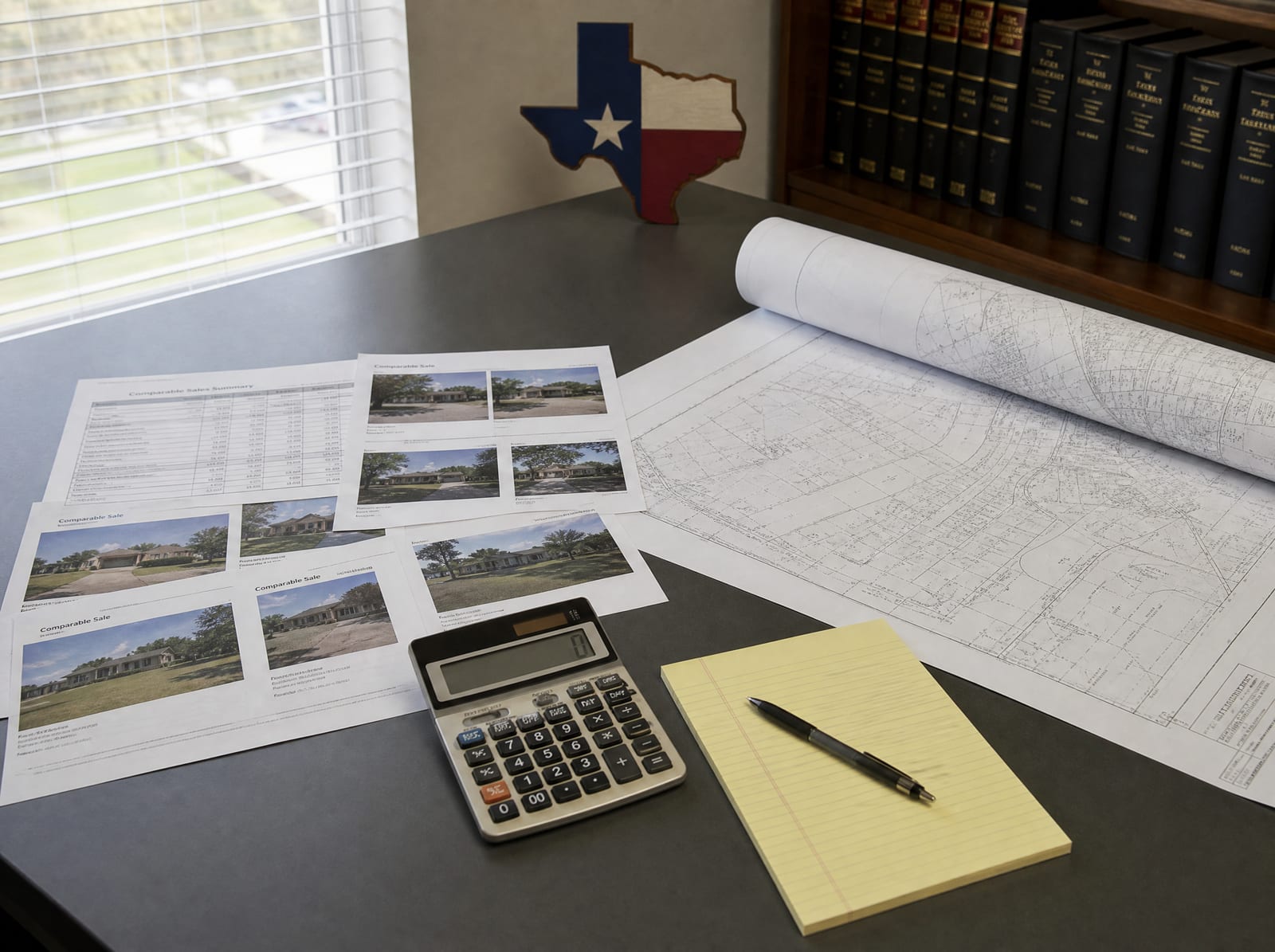
Professional appraisers use three primary approaches to determine fair market value: the sales comparison approach, income approach, and cost approach. The sales comparison approach examines recent sales of similar properties to establish what buyers actually pay in your market. For residential properties, this method typically provides the most reliable valuation basis.
The income approach calculates value based on the income a property generates or could generate at its highest and best use. This method proves particularly relevant for rental properties, agricultural land, or commercial properties where income potential drives market value. The appraiser considers current lease rates, operating expenses, and capitalization rates applicable to similar properties.
The cost approach determines what it would cost to replace the property with one of equal utility, accounting for depreciation. While less commonly relied upon for market value, this approach helps establish the value of unique improvements or specialized properties without active markets. Appraisers often use multiple approaches and reconcile the results to reach a final value opinion.
Texas law requires that property be valued at its highest and best use, even if you're not currently using it that way. If your agricultural land sits in the path of suburban development and could legally be subdivided for residential use, the appraiser must consider that potential rather than valuing it solely as farmland. This principle protects your right to receive compensation based on your property's full market potential.
Common Mistakes That Reduce Your Compensation
Property owners frequently accept inadequate compensation because they don't understand what qualifies for inclusion in just compensation calculations. The government's initial offer typically represents only the land being taken, ignoring damages to the remainder or failing to account for the property's highest and best use. Without experienced legal representation, you might not recognize that you're entitled to significantly more than the first offer suggests.
Many homeowners and landowners assume that because a government appraiser determined the value, the amount must be fair and accurate. Government appraisers work for the condemning authority, not for you. Their valuations often reflect conservative assumptions that minimize compensation. You have the right to hire your own appraiser and challenge valuations that don't reflect true market conditions.
Failing to document damages to remaining property represents another costly mistake. If the taking separates your property from road access, creates an irregular shape that reduces marketability, or eliminates essential infrastructure like wells or septic systems, you must identify and quantify these damages. Waiting until after the taking occurs makes documenting these impacts significantly more difficult.
Some property owners sign right-of-way agreements or accept initial offers without realizing they're waiving their right to challenge the compensation amount. Once you accept payment and sign a release, you typically cannot later claim additional compensation even if you discover the amount was inadequate. Legal review before signing any documents protects your ability to pursue full just compensation.

The Process for Challenging Inadequate Compensation
 1
1Initial Offer Review
The government must provide written notice of the amount it has determined as just compensation before filing a condemnation lawsuit. Review this offer carefully with legal counsel to identify whether it addresses all compensation components and reflects accurate property valuation.
 2
2Independent Appraisal
Hire a qualified appraiser experienced in eminent domain cases to conduct an independent valuation of your property. Your appraiser should analyze the same factors the government considered but without the inherent bias toward minimizing compensation. This independent valuation provides the foundation for challenging an inadequate offer.
 3
3Negotiation Period
Before filing or responding to a condemnation lawsuit, you have the opportunity to negotiate with the condemning authority. Present your independent appraisal and evidence of damages to the remainder. Many cases settle during this phase when the government recognizes its initial valuation underestimated just compensation.
 4
4Special Commissioners Hearing
If negotiation doesn't produce fair compensation, the case proceeds to a hearing before three special commissioners appointed by the court. Both sides present appraisal evidence and testimony about property value and damages. The commissioners then award what they determine to be just compensation based on the evidence presented.
 5
5Appeal to District Court
Either party can appeal the commissioners' award to district court for a trial de novo, meaning the case starts fresh with no deference to the commissioners' decision. The district court trial allows full presentation of evidence, expert testimony, and legal arguments about what constitutes just compensation for your specific property.
Why Experience Matters in Eminent Domain Valuation
Since 1977, Showalter Colgin & Davis, PLLC has represented property owners throughout the Greater Houston area in eminent domain cases. Our attorneys understand the specific valuation challenges that arise in partial takings, infrastructure projects, and cases involving unique property uses. We work with qualified appraisers who know Texas eminent domain law and can present compelling evidence of your property's true value.
Our firm's knowledge of local real estate markets in communities from Houston to Sugar Land, Katy, Pearland, and throughout Fort Bend, Harris, and surrounding counties provides valuable perspective on property valuation issues. We know what comparable sales actually reflect market conditions, understand development trends affecting highest and best use determinations, and recognize when government appraisals rely on inappropriate comparisons.
Eminent domain cases require specific legal knowledge that general practice attorneys typically lack. The rules governing what evidence courts can consider, how appraisers must calculate damages, and what legal standards apply to valuation disputes differ substantially from other property law matters. Our focused practice in eminent domain law means we understand these distinctions and use them to your advantage.
We handle eminent domain cases on a contingency fee basis, meaning you pay attorney fees only if we increase your compensation above what the government initially offered. This arrangement allows you to pursue fair compensation without upfront legal costs and aligns our interests completely with maximizing your recovery.

Frequently Asked Questions About Just Compensation for Eminent Domain
Can the government take my property before paying just compensation?
No. The Texas Constitution requires that just compensation be paid before the government takes possession of your property. If the government needs immediate access, it must deposit the amount it claims is just compensation with the court before taking possession. You can withdraw this deposit without waiving your right to prove you're entitled to more.
How long do I have to challenge the government's valuation?
You typically have limited time to file objections to a special commissioners' award, often just 20 to 30 days depending on the condemning authority. Missing this deadline can forfeit your right to challenge inadequate compensation. Contact an attorney immediately upon receiving any eminent domain notice to preserve all your legal options.
Does just compensation include my moving costs and relocation expenses?
Federal and state law may require payment of relocation benefits separate from just compensation if the project receives federal funding or involves certain state agencies. These benefits can include moving expenses, replacement housing payments, and business relocation costs. However, these amounts are in addition to, not part of, the just compensation for your property's value.
What happens if I disagree with both the government's appraisal and my own appraiser?
Property owners sometimes receive appraisals showing values they believe are too low, even from their own hired experts. If this occurs, you can hire a different appraiser or work with your attorney to identify factors the first appraisal might have missed. The court ultimately decides fair market value based on all evidence presented, not simply the opinions of hired appraisers.
Can I receive compensation for the emotional value my property holds?
Texas law limits just compensation to fair market value and doesn't include compensation for sentimental attachment or emotional distress. However, market value can reflect premium prices buyers might pay for properties with special characteristics or historical significance. If your property has unique features that would attract premium offers in the market, those factors should be reflected in its valuation.
What if the taking only affects my property's access or easements?
The government can take or damage property rights short of full ownership, including access rights, easements, and development rights. You're entitled to just compensation for these partial interests based on how the loss affects your property's market value. Losing highway access or having easements condemned can substantially damage property value and must be properly compensated.
How does the timing of the valuation affect my compensation?
Texas law requires that property be valued as of the date the government files its condemnation petition or takes possession, whichever occurs first. This timing can significantly affect compensation in rapidly developing areas where property values are increasing. If the government delays the taking after providing notice, you may be entitled to updated valuation reflecting current market conditions.
Can I negotiate for the government to purchase my entire property instead of just part of it?
In some cases where a partial taking would severely damage the remainder of your property, you can request that the government purchase the entire parcel. Courts may order a complete taking if the remainder would have little independent economic viability or if the damages to the remainder approach the value of the part not taken. This option depends on specific facts about how the taking affects your property's use and value.
Schedule An Attorney Consultation
Fields marked with an asterisk are required.
Discuss your what is just compensation matter
Contact Showalter Colgin & Davis at (281) 341-5577 to speak with an attorney. We serve property owners, businesses, and families throughout the Greater Houston area.